RARE 1966 Soviet Space Program Archive: Gen Kamanin 8-Page Cosmonaut Draft Manuscript
RARE 1966 Soviet Space Program Archive: Gen Kamanin 8-Page Cosmonaut Draft Manuscript
RARE 1966 SOVIET SPACE PROGRAM ARCHIVAL LOT
Lieutenant General Nikolai P. Kamanin — Head of Cosmonaut Training
Original Complete 8-Page Working Pre-Publication Typescript with Contemporary Hand Corrections
Offered is an extraordinary primary research archive directly from the personal files of Lieutenant General Nikolai P. Kamanin, the legendary chief of cosmonaut selection and training for the Soviet space program.
Prepared in early 1966 in conjunction with the 5th anniversary of Yuri Gagarin's historic April 1961 first manned spaceflight, this complete 8-page Russian-language typescript, titled "СОВЕТСКАЯ ШКОЛА КОСМОНАВТОВ"("The Soviet School of Cosmonauts"), was prepared from an interview conducted by Novosti Press Agency (APN) correspondent Yuri Dokuchaev.
Lot Overview & Specifications:
Format: Original complete 8-page Russian-language pre-publication working carbon-copy typescript.
Provenance: Originally from the personal archival collection of Lieutenant General Nikolai P. Kamanin.
Handwritten Editorial Corrections: annotated throughout with contemporary publishing-house marks in pen and pencil—including word substitutions, stylistic revisions, phrase insertions, deletions, and punctuation changes prior to official print distribution.
Key Historical Content: Kamanin details the complete early doctrine of Soviet human spaceflight, covering:
Theoretical origins from K.E. Tsiolkovsky.
Parabolic flight zero-g testing on jet aircraft and early biological flights (Belka and Strelka).
Cosmonaut physical, psychological, and theoretical training.
Vestibular dysfunction experienced by Gherman Titov aboard Vostok 2 and subsequent training adjustments.
Preparation for extravehicular activity (EVA) and Alexei Leonov’s pioneering spacewalk aboard Voskhod 2.
Analysis of crew selection criteria, age parameters (25–35/40), aircraft commanders vs. specialist passengers (scientists, journalists, cameramen).
Manual re-entry orientation performed by Pavel Belyayev during the emergency recovery of Voskhod 2 near Perm.
Analysis of Valentina Tereshkova’s flight and the future vision for multi-seater spacecraft crews.
Condition:
Fine vintage archival condition across all 8 pages. Authentic 1960s paper toning, edge handling wear, light creasing, and minor paperclip rust marks at top margins. All typewritten text and editorial handwritten markings remain clear, dark, and fully legible.
Full English Translation of the 8-Page Manuscript
[Page 1]
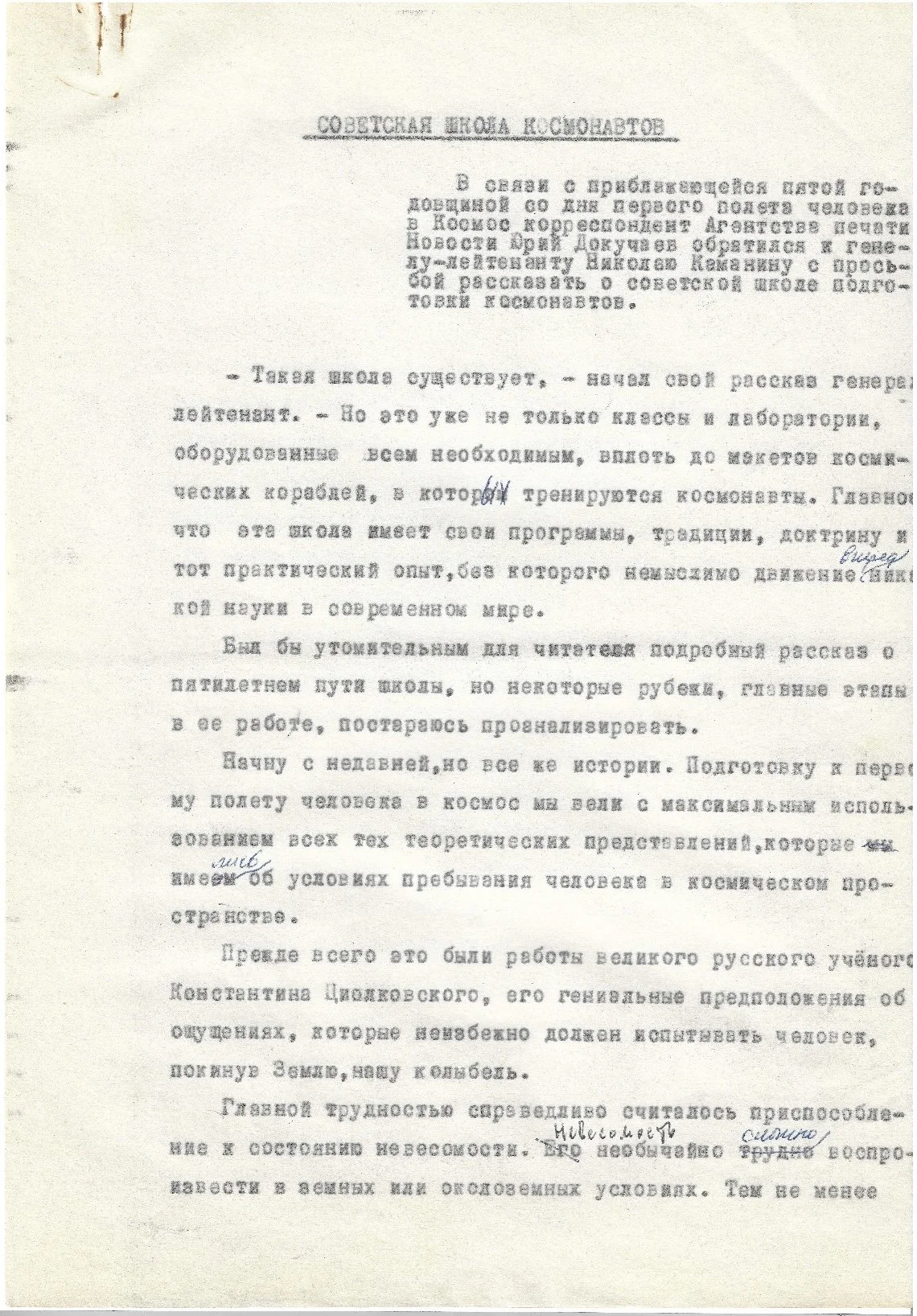
THE SCHOOL OF COSMONAUT TRAINING
In connection with the approaching fifth anniversary of the day of the first human space flight, Novosti Press Agency correspondent Yuri Dokuchaev turned to Lieutenant General Nikolai Kamanin with a request to talk about the Soviet school of cosmonaut training.
"- Such a school exists, - began his story the lieutenant general. - But this is already not only classrooms and laboratories equipped with everything necessary, right down to mock-ups of spacecraft in which cosmonauts train. The main thing is that this school has its own programs, traditions, doctrine, and that practical technical experience without which the movement of any science in the modern world is unthinkable.
It would be tiresome for the reader to have a detailed account of the five-year path of the school, but I will try to analyze some milestones, the main stages in its work.
I will start with recent, but nevertheless history. Preparation for the first human space flight was conducted with the maximum use of all those theoretical concepts that we have regarding the conditions of human existence in outer space.
First of all, these were the works of the great Russian scientist Konstantin Tsiolkovsky, his brilliant assumptions about those sensations that a person must inevitably experience, having left Earth, our cradle.
The main difficulty was rightly considered to be adaptation to the state of weightlessness. It is extraordinarily difficult to reproduce this in terrestrial or near-terrestrial conditions. Nevertheless..."
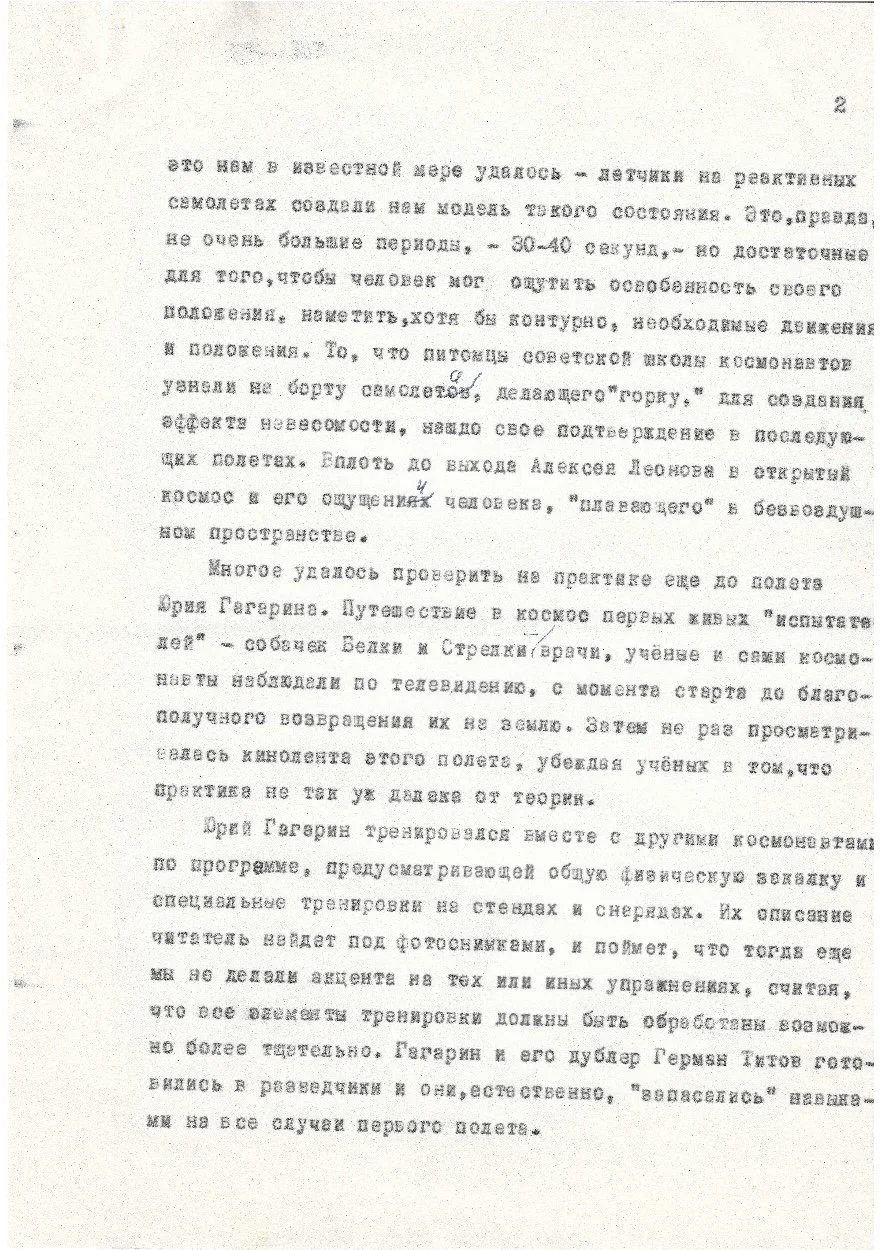
[Page 2]
"...this was achieved by us to a certain extent - pilots on jet aircraft created a model of such a state for us. These, true, are not very large periods - 30-40 seconds - but sufficient for a person to be able to feel the liberation of his position, to outline, at least in contour, the necessary movements and positions. The fact that the pupils of the Soviet school of cosmonauts learned aboard aircraft making a "parabolic arc" to create the effect of weightlessness found its confirmation in subsequent flights. Right up to Alexei Leonov's exit into open space and his sensations as a human "floating" in airless space.
Much was successfully verified in practice even before Yuri Gagarin's flight. The journey into space of the first live "testers" - the small dogs Belka and Strelka - doctors, scientists, and the cosmonauts themselves observed via television, from the moment of launch to their safe return to Earth. Afterward, the film footage of this flight was reviewed more than once, convincing scientists that practice is not all that far from theory.
Yuri Gagarin trained together with other cosmonauts according to a program providing for general physical hardening and special training on rigs and training devices. The reader will find their description under the photographs, and will understand that at that time we still did not place an emphasis on these or those exercises, believing that all elements of training should be worked out as thoroughly as possible. Gagarin and his backup Gherman Titov prepared to be pathfinders, and they, naturally, "stocked up" with skills for all eventualities of the first flight."
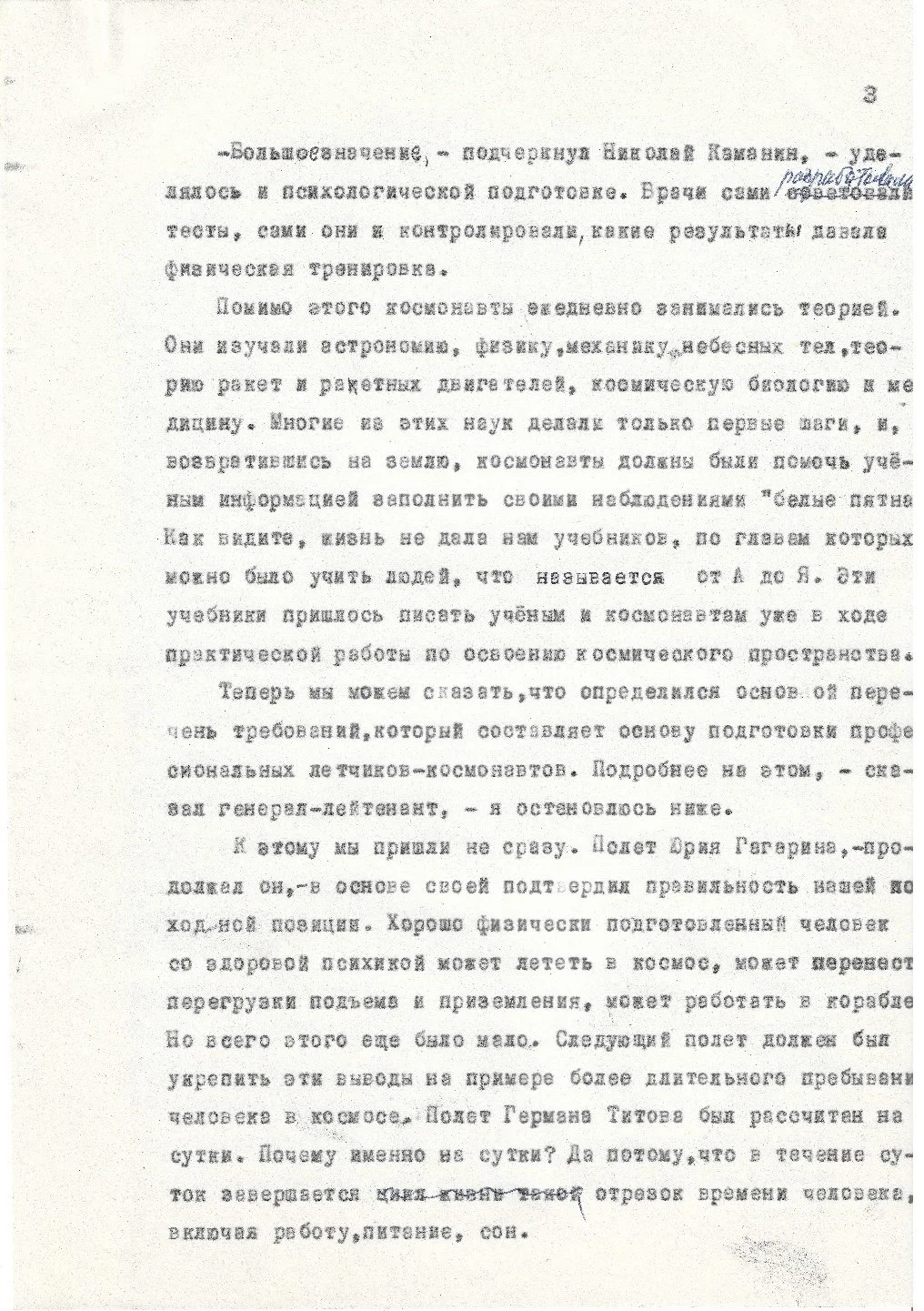
[Page 3]
"- Great importance, - emphasized Nikolai Kamanin, - was also attached to psychological preparation. The doctors themselves conducted tests, and they themselves monitored what results physical training yielded.
In addition to this, cosmonauts engaged in theory daily. They studied astronomy, physics, mechanics of celestial bodies, space navigation, the theory of rockets and rocket engines, space biology and medicine. Many of these sciences were taking only their first steps, and, having returned to Earth, cosmonauts had to help scientists with information, to fill in "blank spots" with their observations. As you see, life did not give us textbooks by chapters of which people could be taught, what is called from A to Z. These textbooks had to be written by scientists and cosmonauts already in the course of practical work on the exploration of outer space.
Now we can say that the main list of requirements has been determined, which forms the basis of the training of professional pilot-cosmonauts. More on this, - said the lieutenant general, - I will dwell below.
To this we did not come all at once. Yuri Gagarin's flight, - he continued, - in the basis of its own confirmed the correctness of our initial position. A physically well-prepared person with a healthy psyche can fly into space, can endure the overloads of ascent and landing, can work in a spacecraft. But all of this was still not enough. The next flight had to strengthen these conclusions on the example of a more prolonged stay of a person in space. Gherman Titov's flight was designed for 24 hours. Why precisely 24 hours? Because within 24 hours the entire cycle of human life is completed, including work, nutrition, sleep."
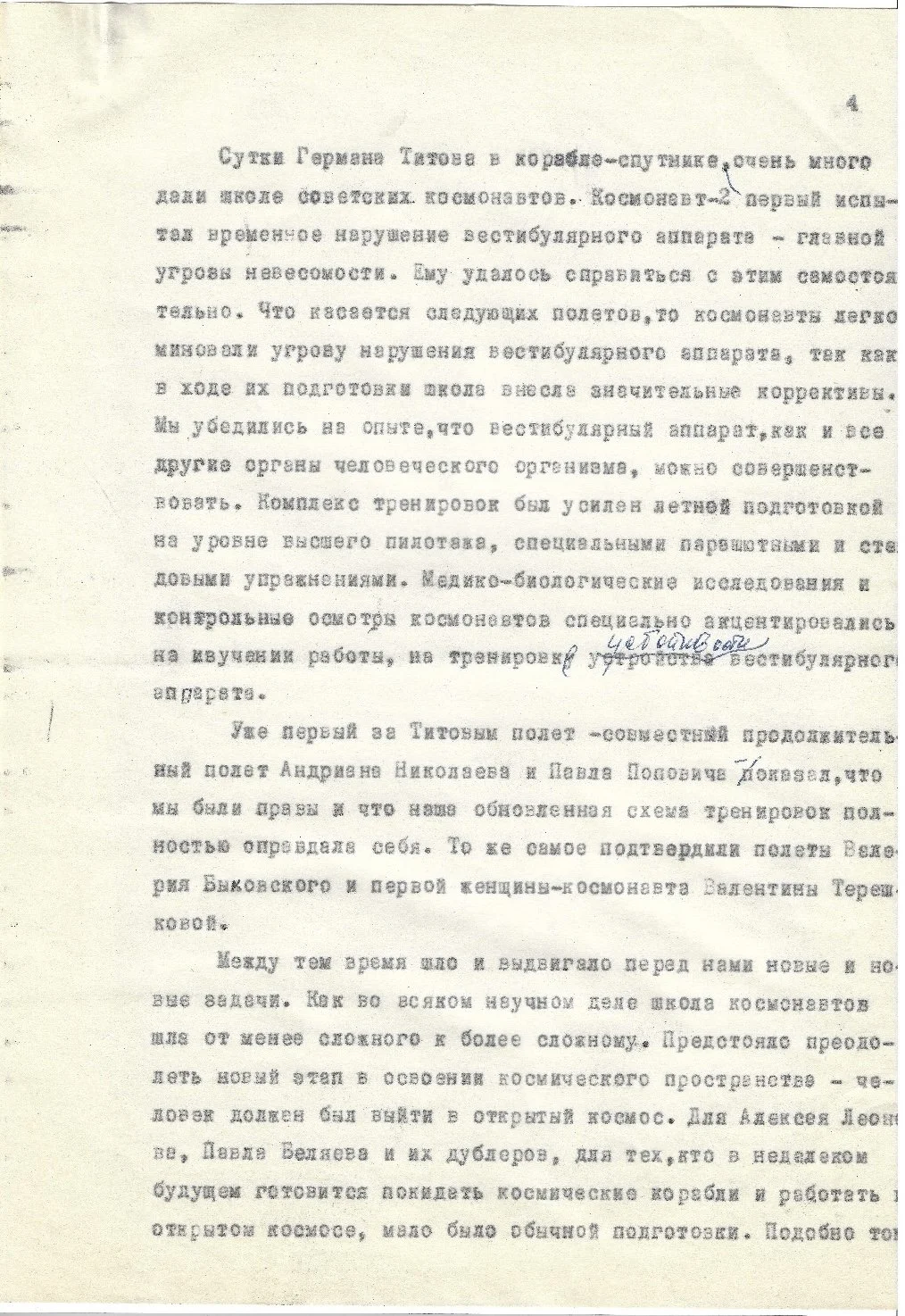
[Page 4]
"The 24 hours of Gherman Titov in the satellite-spacecraft gave a great deal to the school of Soviet cosmonauts. Cosmonaut-2 first experienced a temporary disruption of the vestibular apparatus - the main threat of weightlessness. He managed to cope with this independently. As for subsequent flights, the cosmonauts easily bypassed the threat of vestibular apparatus disruption, because in the course of their training the school introduced significant corrections. We were convinced from experience that the vestibular apparatus, like all other organs of the human organism, can be perfected. The training complex was intensified with flight training at the aerobatics level, special parachute and rig exercises. Biomedical research and routine examinations of cosmonauts were specially focused on the study of the work of the vestibular apparatus.
Already the first flight after Titov - the joint prolonged flight of Andrian Nikolayev and Pavel Popovich - proved that we were right and that our updated training scheme fully justified itself. The same was confirmed by the flights of Valery Bykovsky and the first woman-cosmonaut Valentina Tereshkova.
Meanwhile, time marched on and put before us new and new tasks. As in any scientific endeavor, the school of cosmonauts went from less complex to more complex. It was necessary to overcome a new stage in the exploration of outer space - a person had to go out into open space. For Alexei Leonov, Pavel Belyayev, and their backups, for those who in the near future were to prepare to leave spacecraft and work in open space, ordinary training was not enough."
[Page 5]
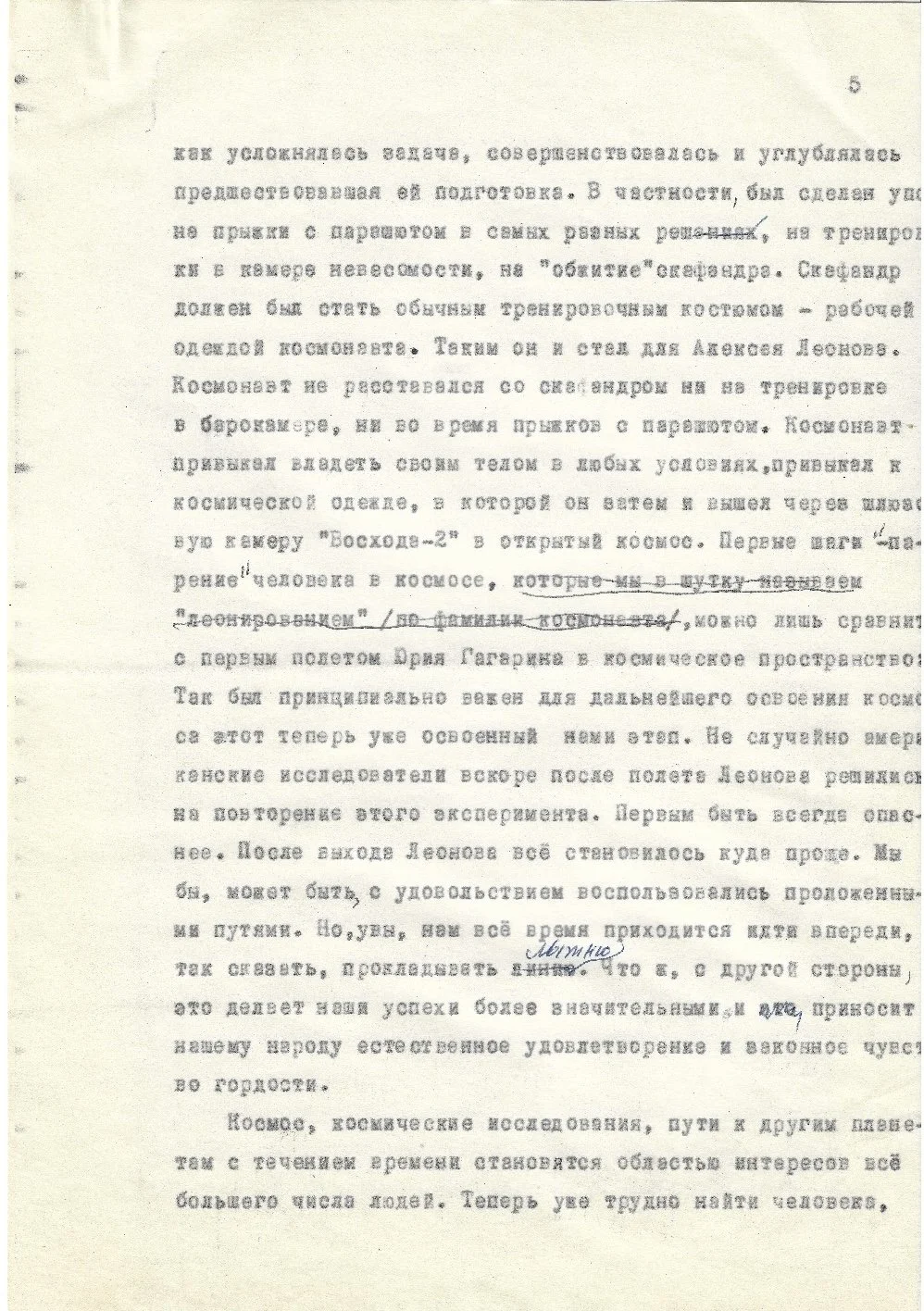
"like how the task was complicated, the training preceding it was perfected and deepened. In particular, an emphasis was made on parachute jumps in the most diverse resolutions, on training in the zero-g chamber, on the "fitting" of the spacesuit. The spacesuit had to become an ordinary training suit - the working attire of the cosmonaut. Such it became for Alexei Leonov. The cosmonaut did not part with the spacesuit neither during training in the altitude chamber, nor during parachute jumps. The cosmonaut grew accustomed to controlling his body in any conditions, grew accustomed to the space clothing in which he then went out through the airlock of "Voskhod-2" into open space. The first steps - the "soaring" of a person in space, which we jokingly call "Leonoving" [crossed out: after the name of the cosmonaut], can only be compared with Yuri Gagarin's first flight into outer space. Thus was fundamentally important for the further exploration of space this stage now already mastered by us. It is no coincidence that American researchers shortly after Leonov's flight decided on the repetition of this experiment. Being first is always more dangerous. After Leonov's exit, everything became much simpler. We would, perhaps, with pleasure have made use of paths already laid. But, alas, we always have to go forward, so to speak, to lay lines [crossed out: flight lines], which, on the other hand, makes our successes more significant and brings our people natural satisfaction and a rightful feeling of pride.
Space, space research, paths to other planets with the passage of time become an area of interest of an ever-greater number of people. Now it is already hard to find a person..."
[Page 6]
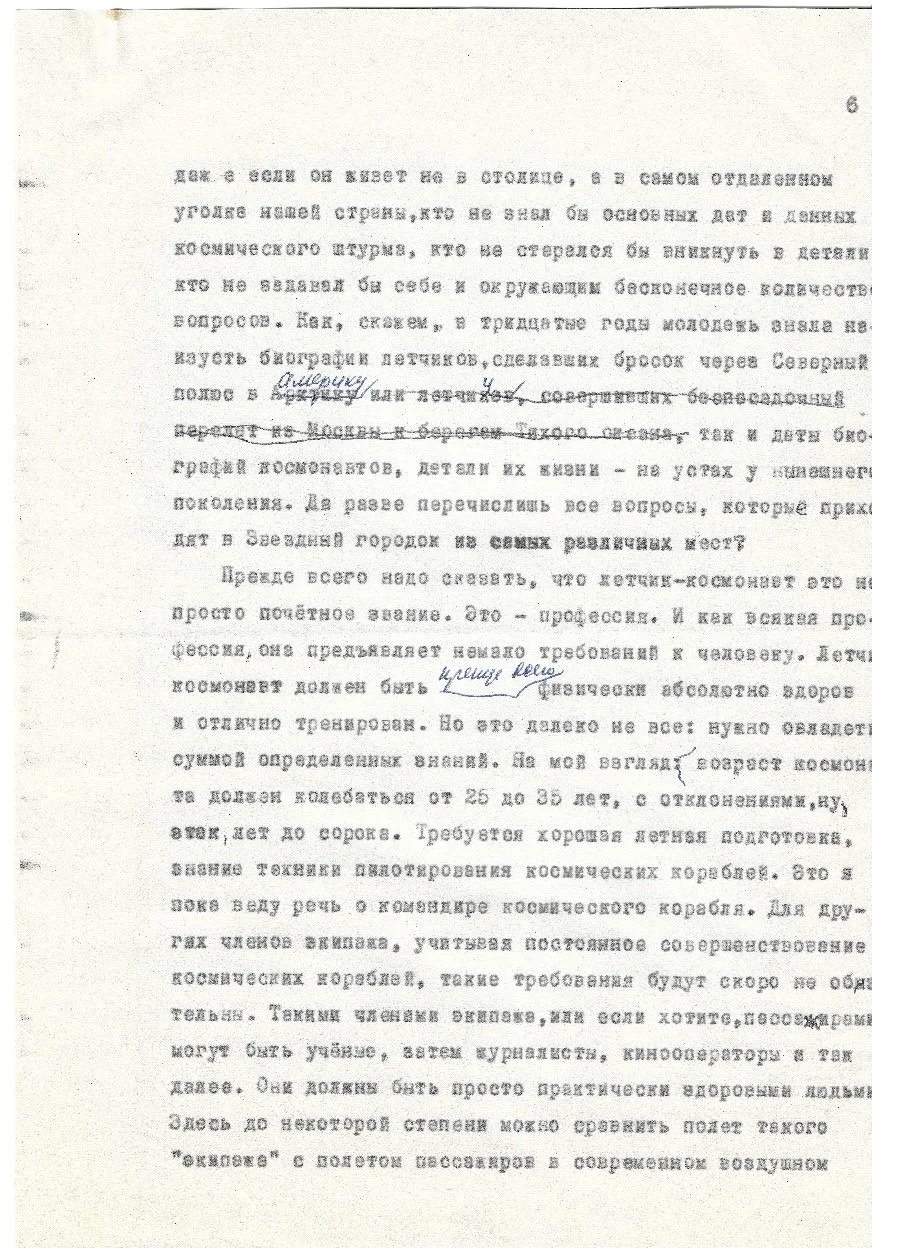
"...even if he lives not in the capital, but in the most remote corner of our country, who would not know the basic dates and data of the space assault, who would not try to delve into details, who would not ask himself and those around him an endless number of questions. As, let's say, in the thirties the youth knew by heart the biographies of pilots who made a dash across the North Pole [crossed out: to America] or pilots who made a non-stop flight from Moscow to the shores of the Pacific Ocean, so too the biographies of cosmonauts, details of their lives - are on the lips of the younger generation. And can you list all the questions that come to Zvezdny Gorodok from the most diverse places?
First of all, it must be said that a pilot-cosmonaut is not simply an honorary title. This is a profession. And like any profession, it puts forward no small number of requirements to a person. A pilot-cosmonaut must be [inserted: absolutely healthy and well-trained] physically absolutely healthy and well-trained. But this is far from everything: it is necessary to master a sum of certain knowledge. In my view, the age of a cosmonaut should range from 25 to 35 years, with deviations, well, say, up to forty. Good flight training is required, knowledge of the technique of piloting spacecraft. This I am still talking about the spacecraft commander. For other crew members, considering the constant improvement of spacecraft, such requirements will soon no longer be mandatory. Such crew members, or if you like, passengers, can be scientists, then journalists, cameramen and so on. They must be simply practically healthy people. Here to a certain degree one can compare the flight of such a "crew" with the flight of passengers in a modern passenger..."
[Page 7]
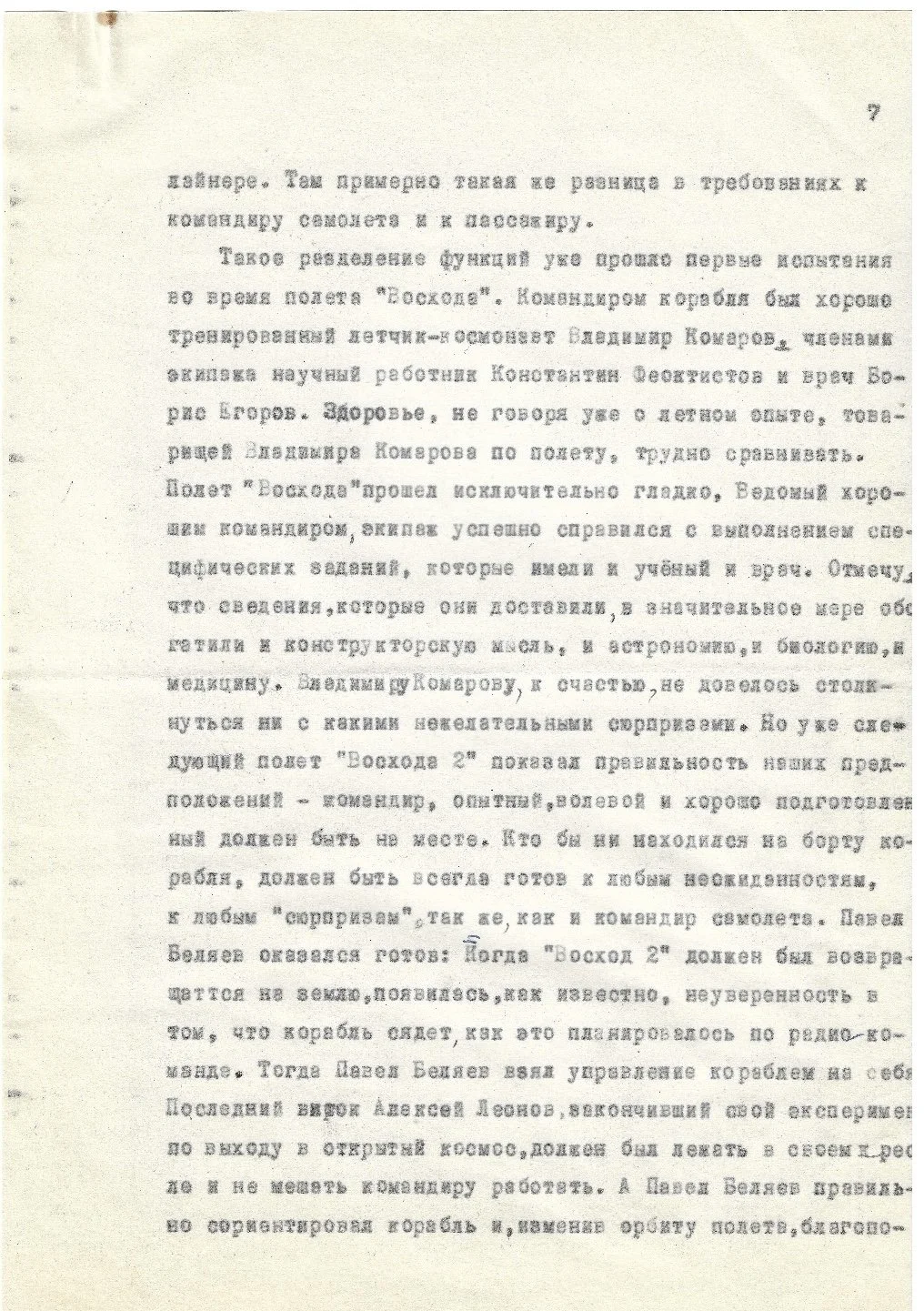
"...airliner. There is approximately the same difference in requirements to the aircraft commander and to the passenger.
Such a division of functions has already passed its initial tests during the flight of "Voskhod". The spacecraft commander was the well-trained pilot-cosmonaut Vladimir Komarov, crew members were researcher Konstantin Feoktistov and physician Boris Egorov. Health, not to mention flight experience, of Vladimir Komarov's flight companions is hard to compare. The flight of "Voskhod" went exceptionally smoothly, led by a good commander, the crew successfully coped with the fulfillment of specific tasks that the scientist and physician also had. I note that the information they delivered significantly enriched engineering thought, astronomy, biology, and medicine. Vladimir Komarov, fortunately, did not have to encounter any undesirable surprises. But already the following flight of "Voskhod 2" showed the correctness of our assumptions - a commander, experienced, strong-willed, and well-trained must be in place. Whoever might be on board a spacecraft must always be ready for any unexpected events, for any "surprises," just like an airplane commander. Pavel Belyayev turned out to be ready: When "Voskhod 2" was to return to Earth, there appeared, as is known, uncertainty as to whether the craft would land as planned by radio command. Then Pavel Belyayev took control of the spacecraft upon himself. On the final orbit Alexei Leonov, having finished his experiment on extravehicular activity, had to lie in his seat and not interfere with the commander working. And Pavel Belyayev correctly oriented the spacecraft and, changing the flight orbit, successfully..."
[Page 8]
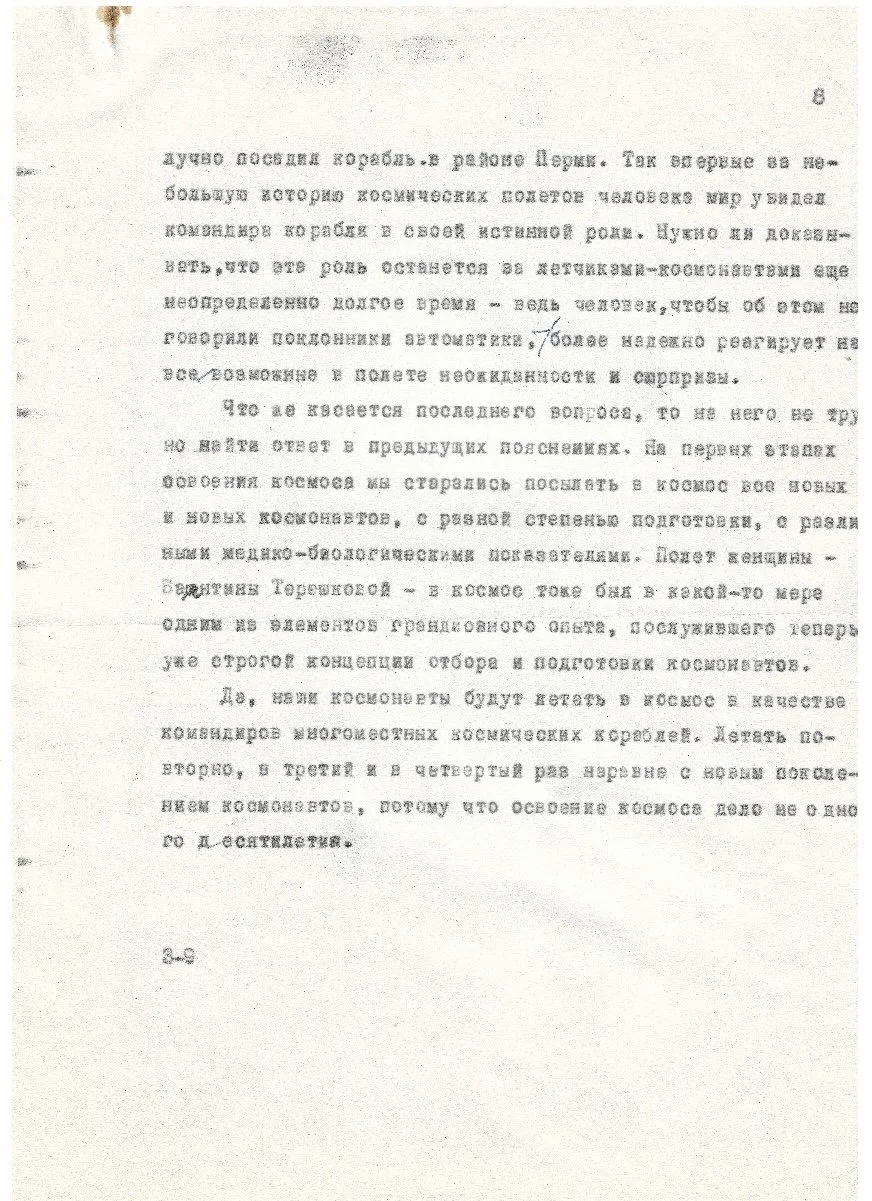
"...landed the craft in the region of Perm. Thus for the first time in the short history of human space flights the world saw the spacecraft commander in his true role. Is it necessary to prove that this role will remain with pilot-cosmonauts for an indefinitely long time - after all, a person, so that fans of automation would not talk about it, [inserted: more reliably reacts] to all possible unexpected events and surprises in flight.
As for the last question, it is not hard to find an answer to it in previous explanations. At the initial stages of space exploration we tried to send into space ever new and new cosmonauts, with varying degrees of training, with various biomedical indicators. The flight of a woman - Valentina Tereshkova - into space was also to some extent one of the elements of grandiose experience, serving now already the strict concept of selection and training of cosmonauts.
Yes, our cosmonauts will fly into space as commanders of multi-seat spacecraft. To fly second, third, and fourth time on a par with a new generation of cosmonauts, because the exploration of space is the business of more than one decade.