RARE 1966 Soviet Space Program Document: Gen Kamanin Handwritten Folder & Draft
RARE 1966 Soviet Space Program Document: Gen Kamanin Handwritten Folder & Draft
RARE 1966 SOVIET SPACE PROGRAM ARCHIVAL LOT
Lieutenant General Nikolai P. Kamanin — Head of Cosmonaut Training
Original Working Pre-Publication Typescript & Editorial Drafts with Extensive Soviet Publishing Hand Corrections
Offered is an extraordinary, highly historical archive directly from the personal files of Lieutenant General Nikolai P. Kamanin, the legendary chief of cosmonaut selection and training for the Soviet space program. Prepared in early 1966 in conjunction with the 5th anniversary of Yuri Gagarin's historic April 1961 first manned spaceflight, this lot offers a rare look into Soviet space history and state publishing censorship/editing.
Title: СОВЕТСКАЯ ШКОЛА КОСМОНАВТОВ ("The Soviet School of Cosmonauts")
Format: Original Russian-language edited carbon typescript prepared from an interview conducted by Novosti Press Agency (APN) correspondent Yuri Dokuchaev.
7 pages size of each page is 9” x 9.1/2”, these 7 pages placed in Kamanin’s Original Annotated Personal File Folder.
Annotations: Heavily annotated throughout with contemporary handwritten editorial marks in pen and pencil—including word substitutions, stylistic revisions, deletions, structural changes, and line edits typical of official Soviet publishing houses before final print runs.
Content: Kamanin details the early evolution of Soviet cosmonaut selection and training from Vostok through Alexei Leonov’s pioneering Voskhod 2 spacewalk. Includes discussions on zero-g simulation, psychological conditioning, aerospace medicine, parachute/survival training, and technical preparation, alongside specific commentary on missions flown by Gagarin, Titov, Tereshkova, Komarov, Belyayev, Feoktistov, Yegorov, and Leonov.
Earlier Draft Working Version: An earlier draft version of the same interview featuring primary editing marks, offering an exceptional comparative look at how Soviet space doctrine was shaped and censored before public release.
Kamanin’s Original Annotated Personal File Folder:
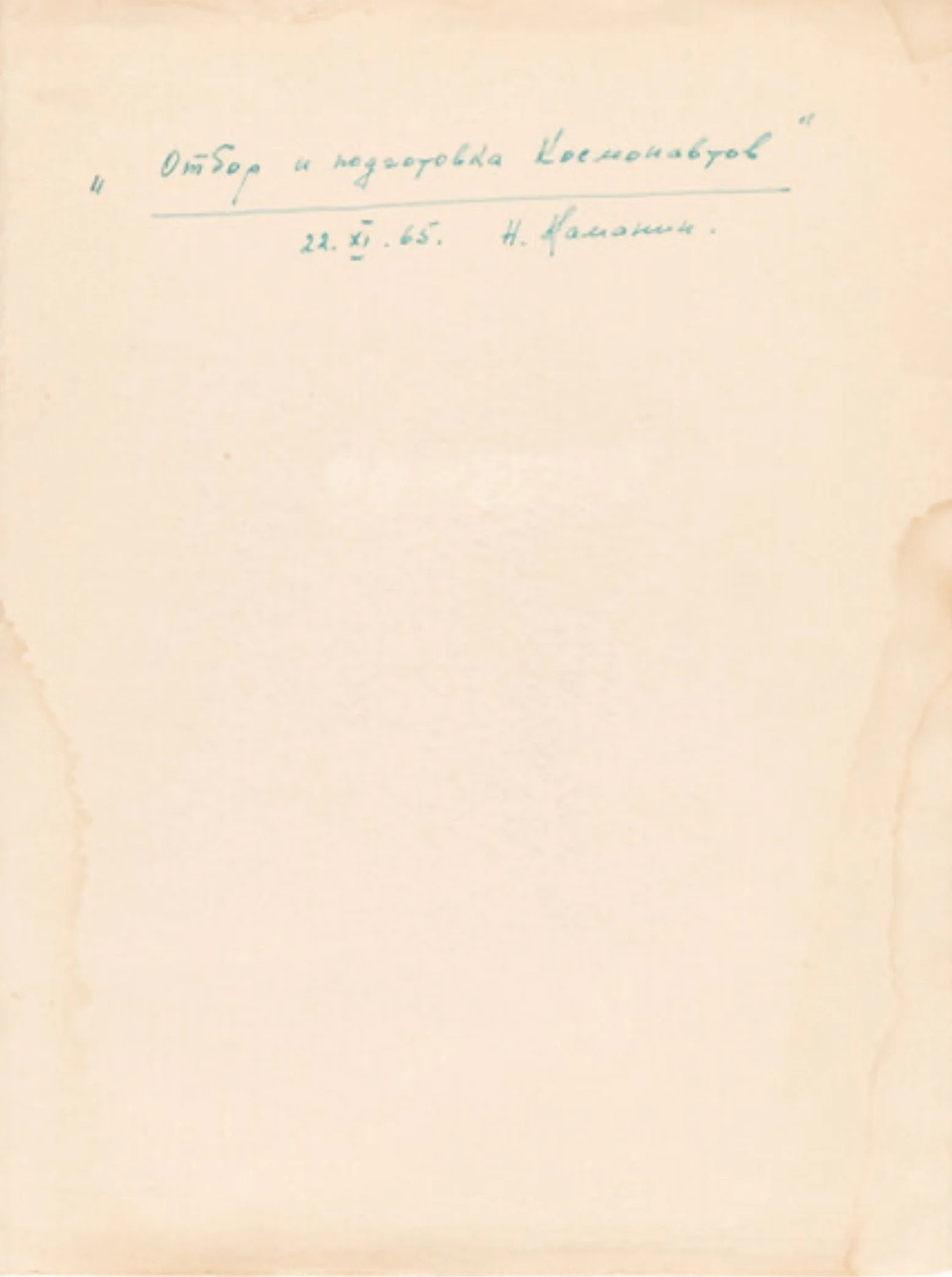
"This lot includes Kamanin's original annotated personal file folder, featuring his handwritten inscription on the cover:
“Отбор и подготовка Космонавтов” / 22.XI.65 / Н. Каманин
(“Selection and Training of Cosmonauts” / November 22, 1965 / N. Kamanin).
Housed inside this original folder are 7 typescript pages, each measuring approximately 9" x 8.5"
Historical Context & Significance:
As Chief of Cosmonaut Training (1960–1971), Nikolai Kamanin was one of the central architects of the early Soviet space effort, overseeing the First Cosmonaut Detachment. Original pre-publication working documents, press drafts, and official editorial files from Kamanin's personal archive are exceedingly scarce compared to mass-produced Soviet books or press releases.
Condition:
Good vintage archival condition. Authentic age toning, handling wear along edges, minor creasing, rust marks from paperclips at top margins, and original ink/pencil editorial markings throughout. Pages remain clear and fully legible.
Here is the full English translation of the 1966 interview typescript featuring Lieutenant General Nikolai Kamanin, titled "The Soviet School of Cosmonauts".
[Page 1]
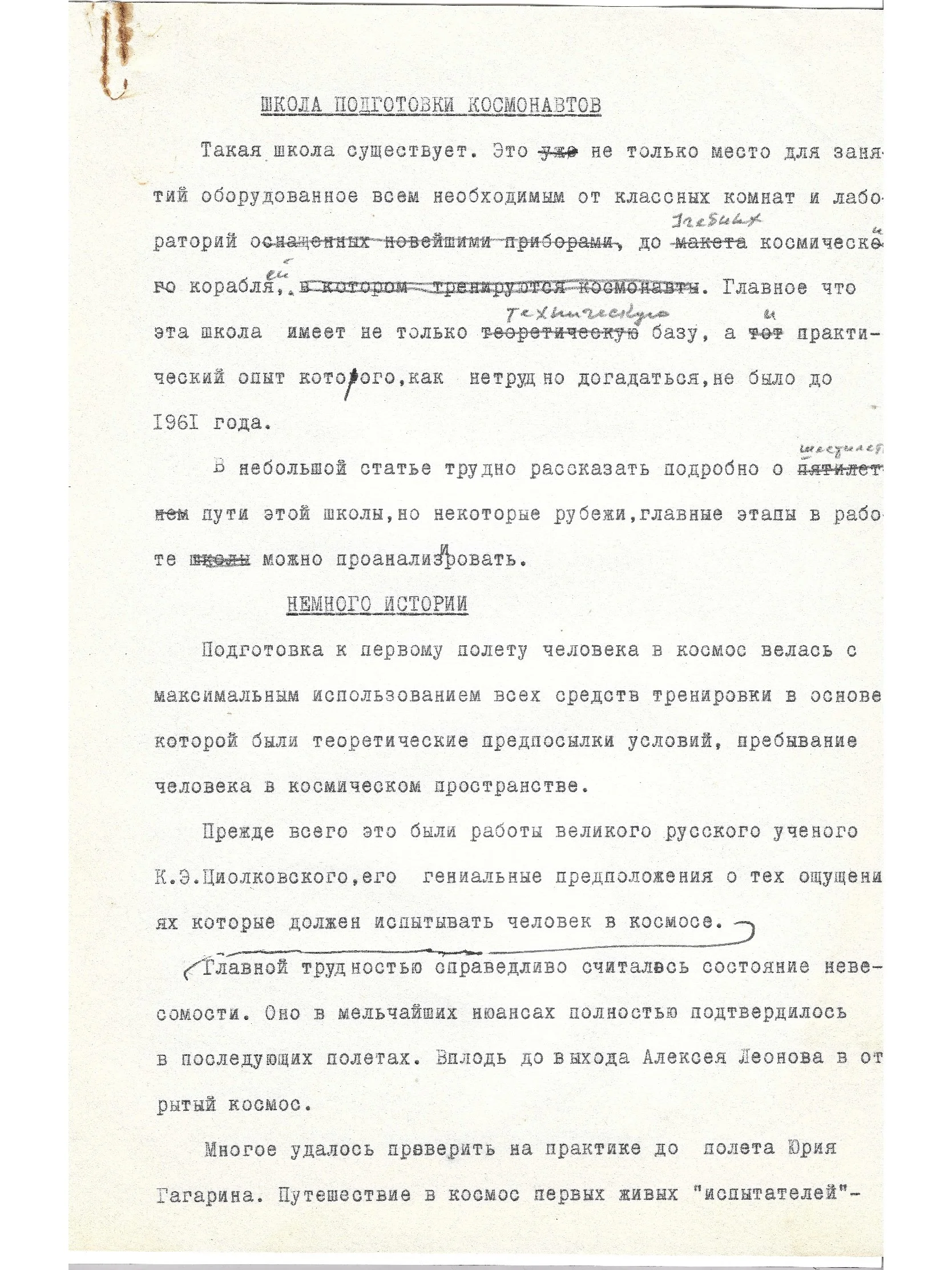
THE SCHOOL OF COSMONAUT TRAINING
Such a school exists. This is not only a place for studies equipped with everything necessary, from classrooms and laboratories equipped with the newest instruments, to a mock-up of a spacecraft in which cosmonauts train. The main thing is that this school has not only a theoretical basis, but also that practical technical experience which, as is not difficult to guess, did not exist until 1961.
In a short article, it is difficult to talk in detail about the five-year path of this school, but some milestones and main stages in the work can be analyzed.
A BIT OF HISTORY
Preparation for the first human space flight was conducted with the maximum use of all training tools, the basis of which were theoretical assumptions regarding the conditions of a human's stay in outer space.
First of all, these were the works of the great Russian scientist K.E. Tsiolkovsky, his brilliant assumptions about those sensations that a person must experience in space.
The main difficulty was rightly considered to be the state of weightlessness. It was confirmed in the smallest details in subsequent flights, right up to Alexei Leonov's extravehicular activity in open space.
Much was successfully verified in practice before Yuri Gagarin's flight. The journey into space of the first living "testers"—
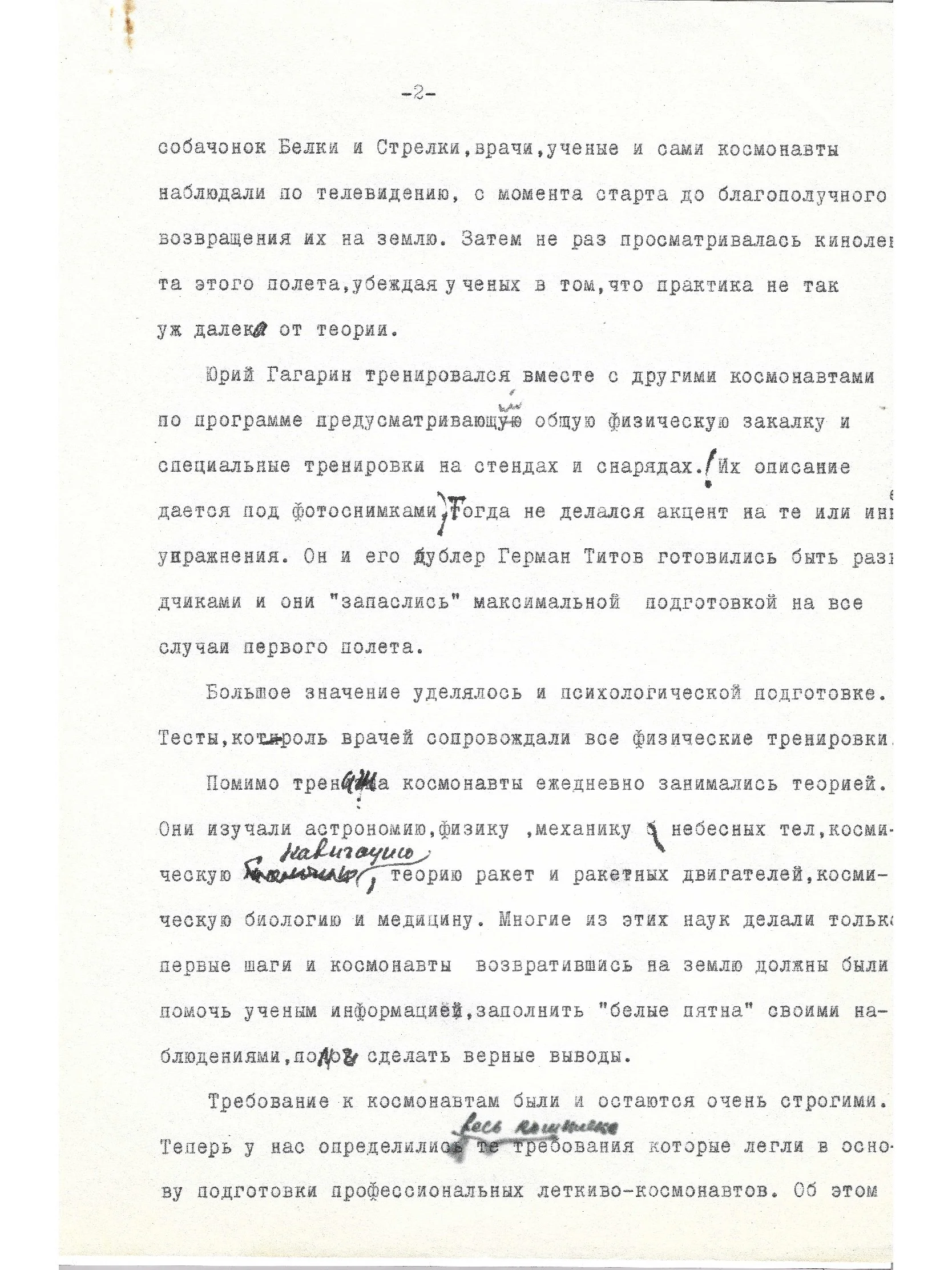
[Page 2]
[- 2 -]
the small dogs Belka and Strelka—was observed by doctors, scientists, and the cosmonauts themselves via television,from the moment of launch to their safe return to Earth. Afterwards, the film footage of this flight was reviewed more than once, convincing scientists that practice is not all that far from theory.
Yuri Gagarin trained with other cosmonauts according to a program providing for general physical hardening and special training on rigs and training devices. Their description is given under photographs. At that time, no special emphasis was placed on these or those exercises. He and his backup, Gherman Titov, prepared to be pathfinders, and they "stocked up" with maximum preparation for all eventualities of the first flight.
Great importance was also attached to psychological preparation. Tests and medical control accompanied all physical training.
In addition to training equipment, the cosmonauts engaged in theory daily. They studied astronomy, physics, mechanics of celestial bodies, space navigation, the theory of rockets and rocket engines, space biology and medicine. Many of these sciences were taking only their first steps, and cosmonauts, having returned to Earth, had to help scientists with information, fill in "blank spots" with their observations, and help draw correct conclusions.
The requirements for cosmonauts were and remain very strict. Now we have determined those requirements that formed the basis of the training of professional pilot-cosmonauts. About this—
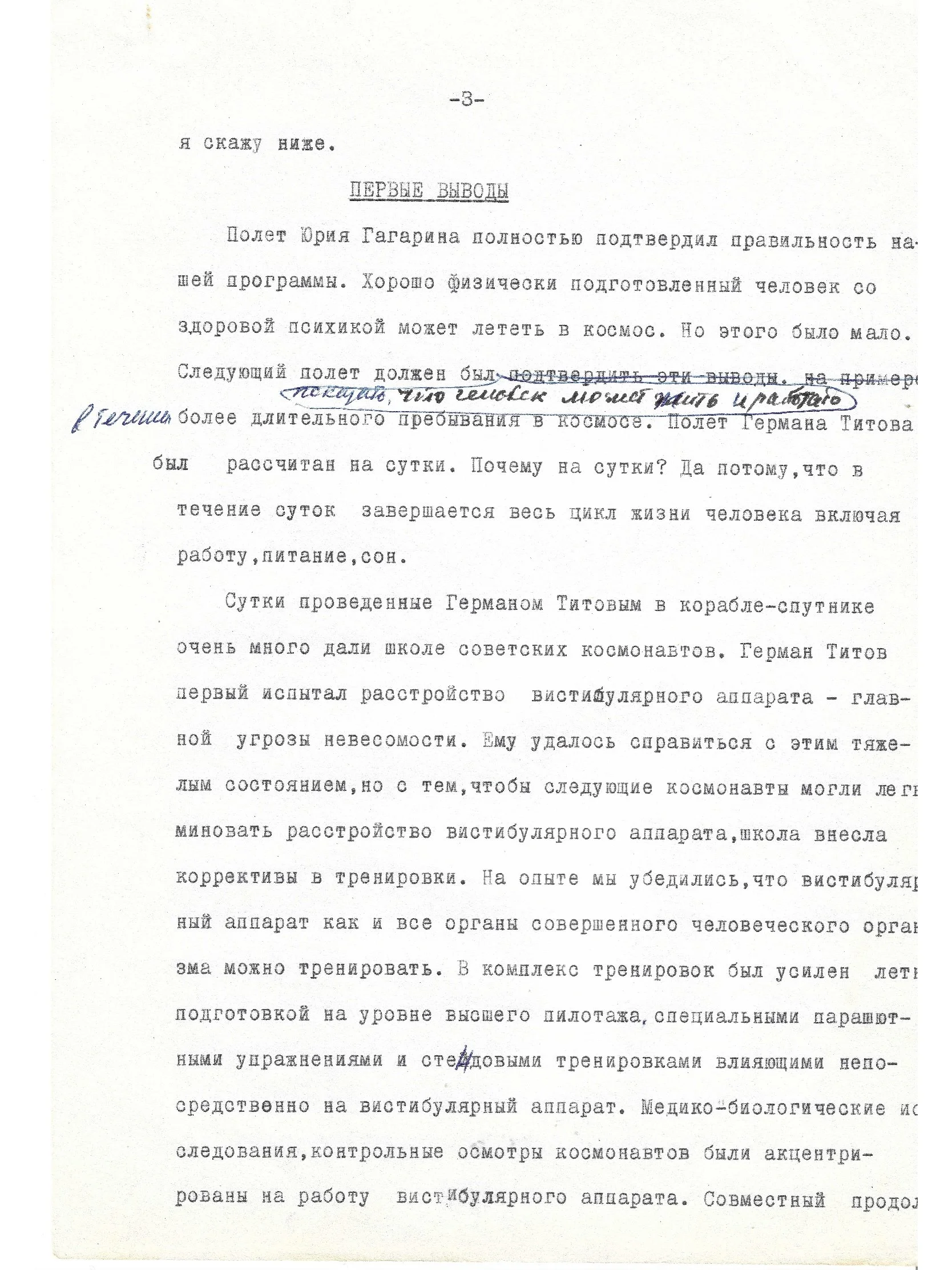
[Page 3]
[- 3 -]
I will speak lower [below].
FIRST CONCLUSIONS
Yuri Gagarin's flight fully confirmed the correctness of our program. A physically well-prepared person with a healthy psyche can fly into space. But this was not enough.
The next flight had to prove that a person can live and work during a more prolonged stay in space. Gherman Titov's flight was designed for 24 hours. Why 24 hours? Because within 24 hours the entire cycle of human life is completed, including work, nutrition, and sleep.
The 24 hours spent by Gherman Titov in the satellite-spacecraft gave a great deal to the school of Soviet cosmonauts.Gherman Titov was the first to experience vestibular apparatus dysfunction—the main threat of weightlessness. He managed to cope with this difficult condition, but in order for subsequent cosmonauts to be able to bypass vestibular disorders, the school made adjustments to the training. Based on experience, we became convinced that the vestibular apparatus, like all organs of a complex human organism, can be trained. The training complex was intensified with flight training at the aerobatics level, special parachute exercises, and rig training directly affecting the vestibular apparatus.Biomedical research and routine examinations of cosmonauts were focused on the work of the vestibular apparatus. The joint pro- [continued]
[Page 4]
[- 4 -]
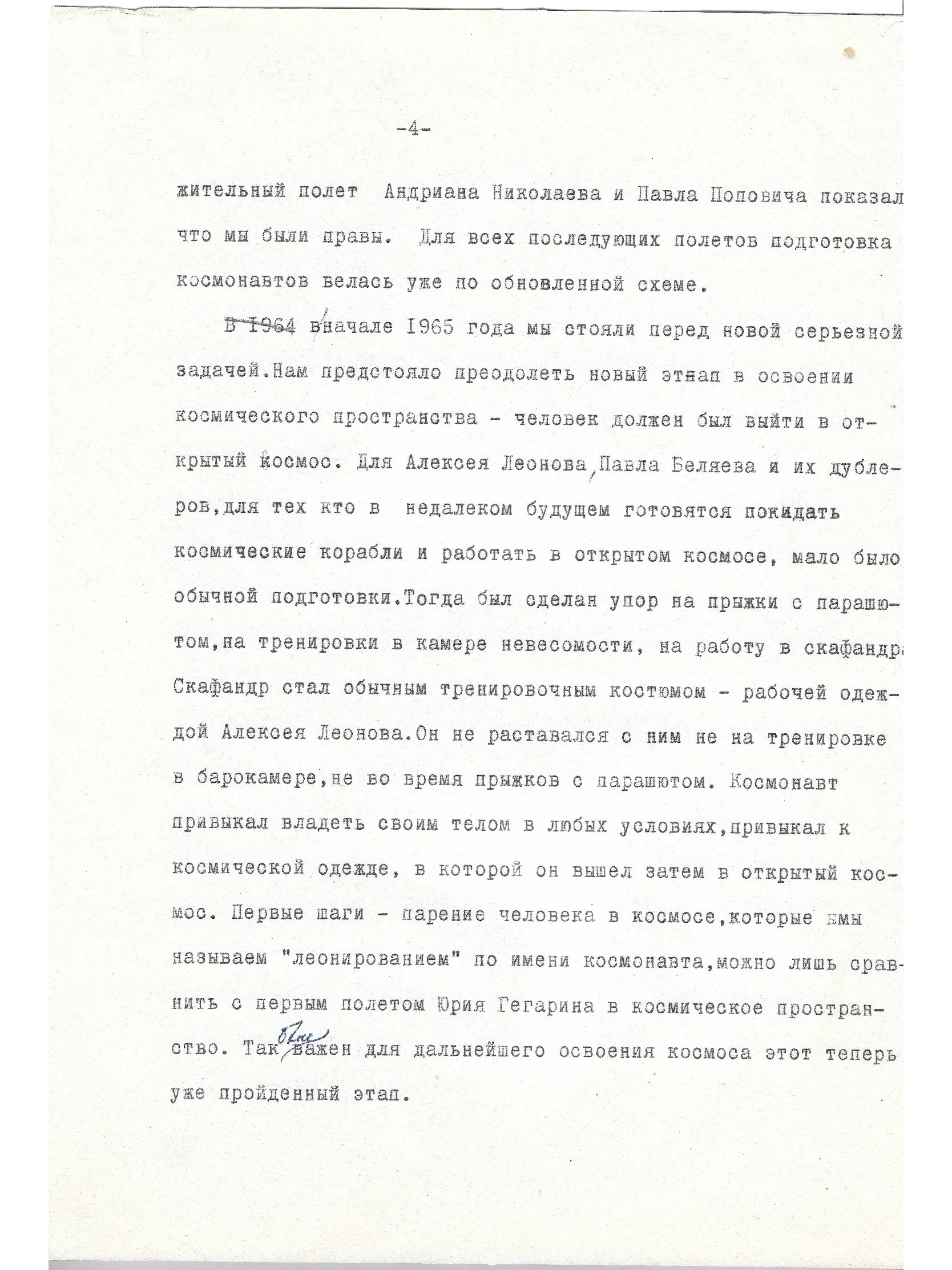
-longed flight of Andrian Nikolayev and Pavel Popovich showed that we were right. For all subsequent flights, cosmonaut training was conducted according to an updated scheme.
In 1964 [corrected to: early 1965], we faced a new, serious task. We had to overcome a new stage in the exploration of outer space—a person had to go out into open space. For Alexei Leonov, Pavel Belyayev, and their backups—for those who in the near future were to prepare to leave spacecraft and work in open space—ordinary training was not enough. At that time, emphasis was placed on parachute jumps, training in the zero-g chamber, and work in a spacesuit. The spacesuit became an ordinary training suit—the working attire of Alexei Leonov. He did not part with it either during training in the altitude chamber or during parachute jumps. The cosmonaut grew accustomed to controlling his body in any conditions,grew accustomed to the space suit in which he subsequently stepped out into open space. The first steps—the soaring of a person in space, which we call "Leonoving" after the name of the cosmonaut—can only be compared with Yuri Gagarin's first flight into outer space. So important for the further exploration of space is this now-passed stage.
[Page 5]
[- 5 -]
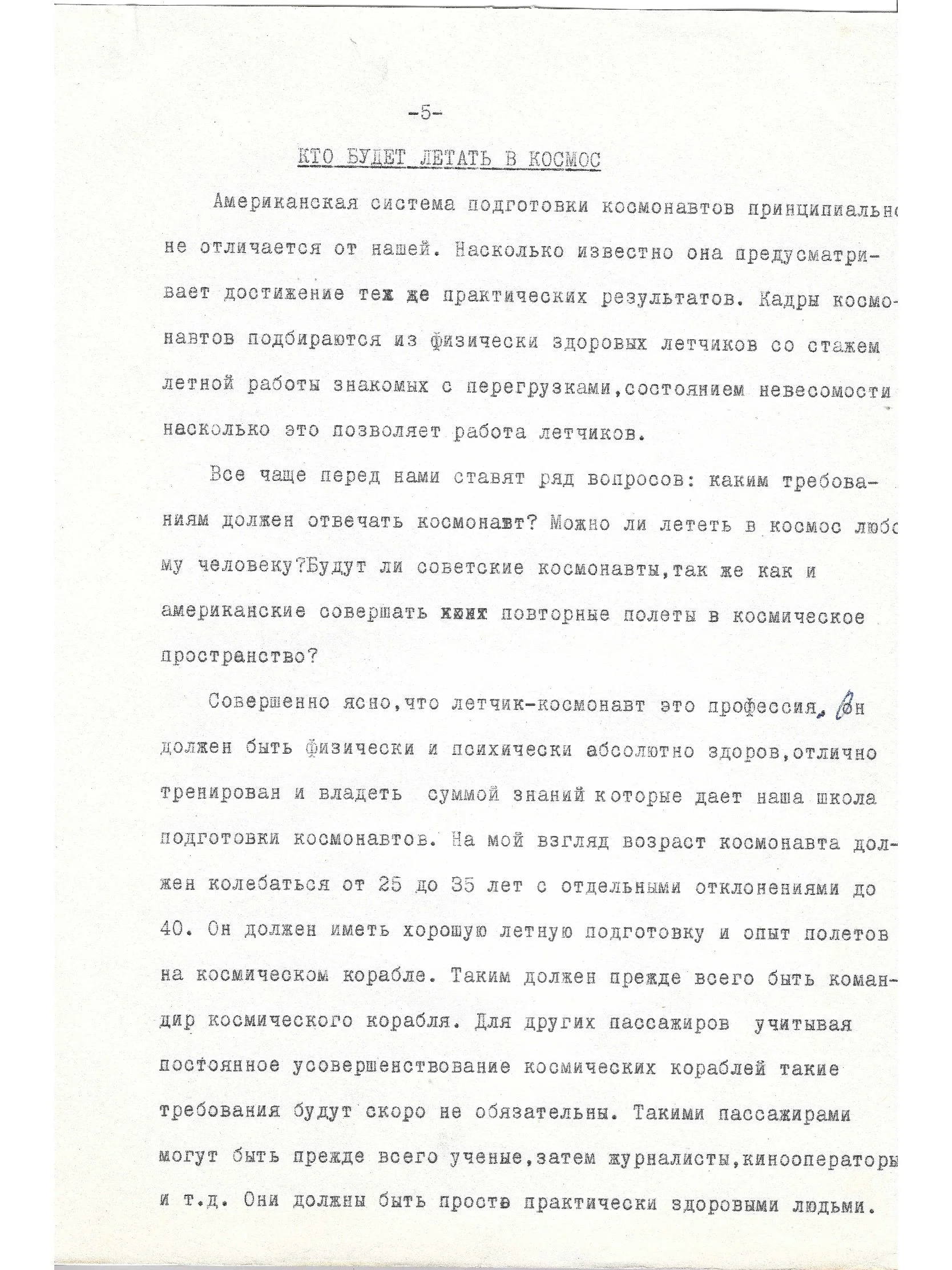
WHO WILL FLY INTO SPACE
The American system of cosmonaut training does not differ in principle from ours. As far as is known, it provides for the achievement of the same practical results. Cosmonaut personnel are selected from physically healthy pilots with a background of flight work who are familiar with overloads and the state of weightlessness to the extent that pilot work permits.
Increasingly, a number of questions are put before us: What requirements must a cosmonaut meet? Can anyone fly into space? Will Soviet cosmonauts, like Americans, make repeated flights into outer space?
It is completely clear that a pilot-cosmonaut is a profession; he must be absolutely healthy physically and mentally,excellently trained, and possess the sum of knowledge imparted by our cosmonaut training school. In my view, the age of a cosmonaut should range from 25 to 35 years, with occasional deviations up to 40. He must have good flight training and flight experience on a spacecraft. First of all, this must be a spacecraft commander. For other passengers, considering the constant improvement of spacecraft, such requirements will soon no longer be mandatory. Such passengers can be, first of all, scientists, then journalists, cameramen, etc. They must be simply practically healthy people.
[Page 6]
[- 6 -]
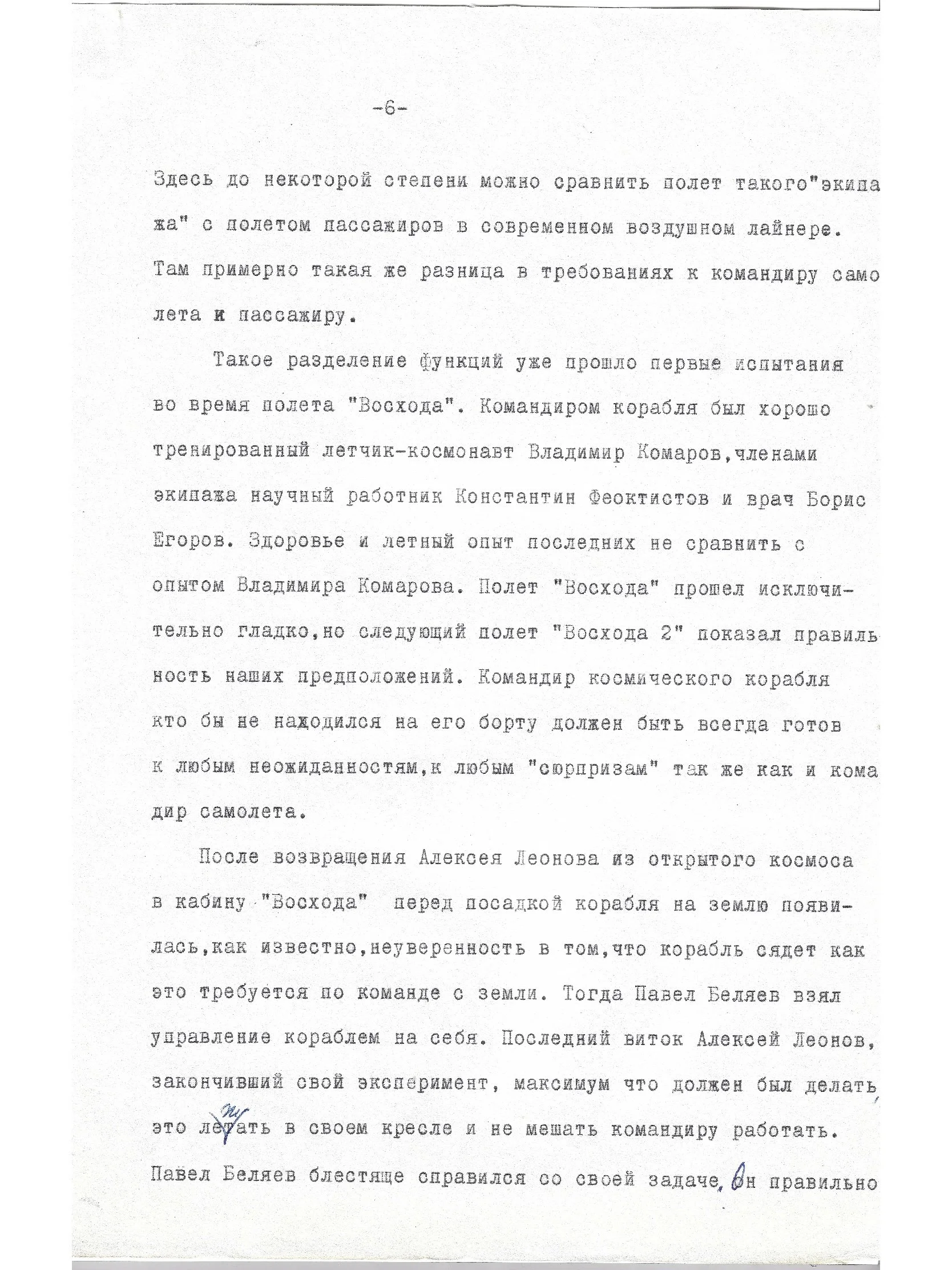
Here, to a certain degree, one can compare the flight of such a "crew" with the flight of passengers in a modern airliner.There is approximately the same difference in requirements for the aircraft commander and the passenger.
Such a division of functions has already passed its initial tests during the flight of "Voskhod." The spacecraft commander was the well-trained pilot-cosmonaut Vladimir Komarov, and the crew members were researcher Konstantin Feoktistov and physician Boris Yegorov. The health and flight experience of the latter cannot be compared with the experience of Vladimir Komarov. The "Voskhod" flight went exceptionally smoothly, but the next flight, "Voskhod 2," showed the correctness of our assumptions. The spacecraft commander, whoever he might be on board, must always be ready for any unexpected events, for any "surprises," just like an airplane commander.
After Alexei Leonov's return from open space into the "Voskhod" cabin before the spacecraft's landing on Earth, there appeared, as is known, uncertainty as to whether the craft would land as required by command from the ground. Then Pavel Belyayev took control of the spacecraft upon himself. On the final orbit, Alexei Leonov, having finished his experiment, all he had to do was to sit in his seat and not interfere with the commander's work. Pavel Belyayev brilliantly coped with his task—he correctly
[Page 7]
[- 7 -]
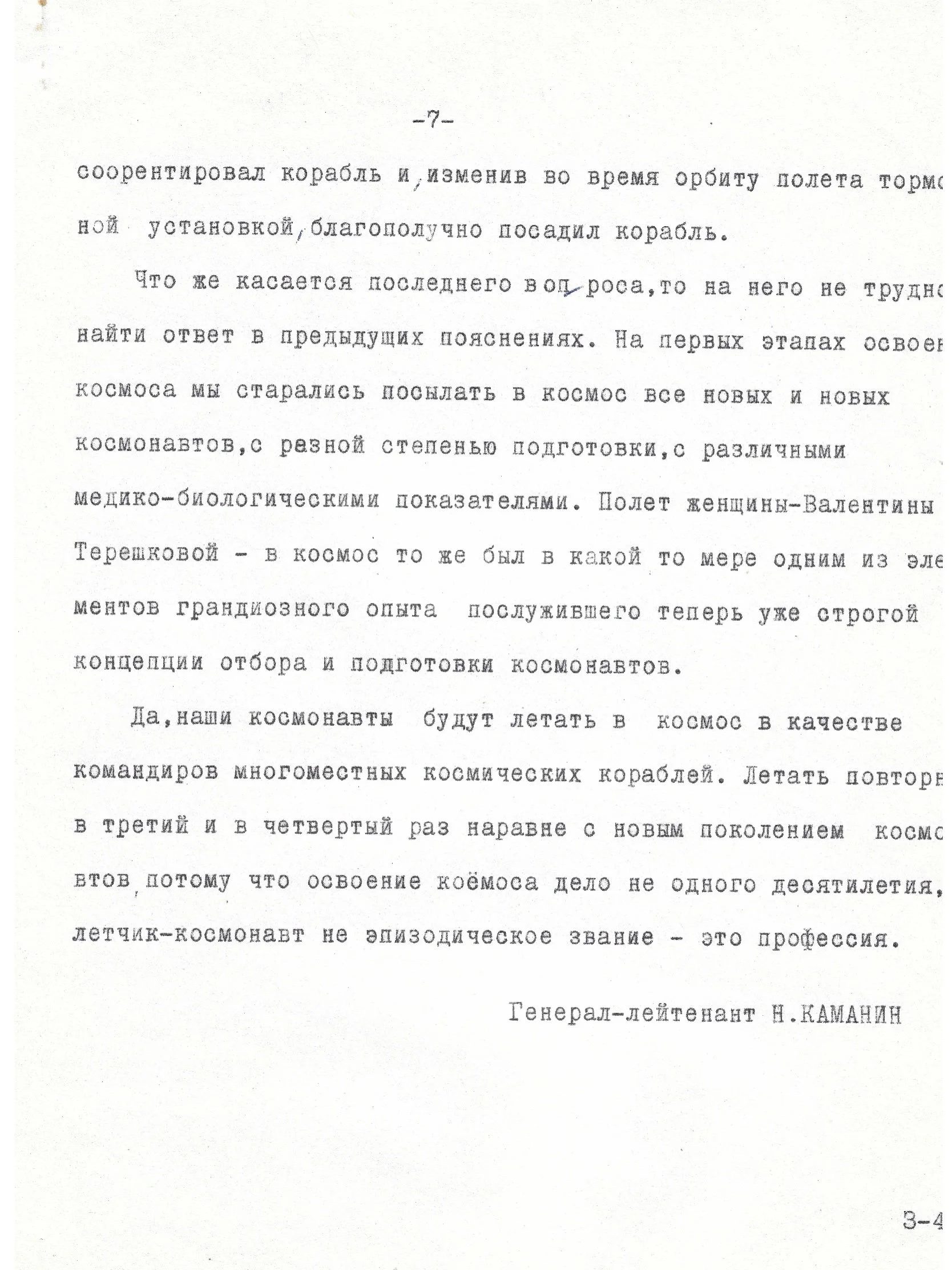
oriented the spacecraft and, having changed the flight orbit with the braking unit, successfully landed the craft.
As for the latter question, the answer is not hard to find in the previous explanations. At the initial stages of space exploration, we tried to send new and newer cosmonauts into space, with varying degrees of training, with various biomedical indicators. The flight of a woman—Valentina Tereshkova—into space was also to some extent one of the elements of grand experience that now serves as the strict concept of cosmonaut selection and training.
Yes, our cosmonauts will fly into space as commanders of multi-seat spacecraft. To fly repeatedly—for the third and fourth time—on a par with a new generation of cosmonauts, because the exploration of space is the business of more than one decade, and a pilot-cosmonaut is not an episodic title—it is a profession.
Lieutenant General N. KAMANIN